
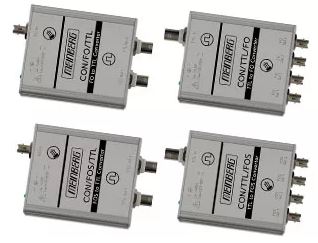
FO Converter / Diplexer
The MEINBERG fiber optic modules convert an electrical input signal (TTL or RS-422) into one or more FO (fiber optical) output signals or an FO input signal in one or more electrical output signals. The FO modules are suitable to spread signals like IRIG (AM / DCLS), PPS or RS232 over wide distances.
- Product Summary
- Product Details
-
The MEINBERG fiber optic modules convert an electrical input signal (TTL or RS-422) into one or more FO (fiber optical) output signals or an FO input signal in one or more electrical output signals. The FO modules are suitable to spread signals like IRIG (AM / DCLS), PPS or RS232 over wide distances.
-
Overview: FO Converter / Diplexer
FO CONVERTER
Fiber Optic ConverterThe MEINBERG fiber optic modules convert an electrical input signal (TTL or RS-422) into one or more FO (fiber optical) output signals or an FO input signal in one or more electrical output signals. The FO modules are suitable to spread signals like IRIG (AM / DCLS), PPS or RS232 over wide distances.

SDU/FO
Extension of existing fiber - optical signals with additional fiber optical outputs.Meinberg SDU/FO devices are the simplest and most convenient way to add more buffered timing signal outputs to your distribution rack. The SDU/FO base chassis can be ordered with one or two distribution modules, each providing up to twelve additional fiber optic signals.

More than: https://www.meinbergglobal.com/english/products/fo-converter-diplexer.htm
Product Summary
The MEINBERG fiber optic modules convert an electrical input signal (TTL or RS-422) into one or more FO (fiber optical) output signals or an FO input signal in one or more electrical output signals. The FO modules are suitable to spread signals like IRIG (AM / DCLS), PPS or RS232 over wide distances.
Product Details
Overview: FO Converter / Diplexer
FO CONVERTER
Fiber Optic Converter
The MEINBERG fiber optic modules convert an electrical input signal (TTL or RS-422) into one or more FO (fiber optical) output signals or an FO input signal in one or more electrical output signals. The FO modules are suitable to spread signals like IRIG (AM / DCLS), PPS or RS232 over wide distances.
SDU/FO
Extension of existing fiber - optical signals with additional fiber optical outputs.
Meinberg SDU/FO devices are the simplest and most convenient way to add more buffered timing signal outputs to your distribution rack. The SDU/FO base chassis can be ordered with one or two distribution modules, each providing up to twelve additional fiber optic signals.
More than: https://www.meinbergglobal.com/english/products/fo-converter-diplexer.htm
Brief overview of FO Converter / Diplexer
The MEINBERG fiber optic modules convert an electrical input signal (TTL or RS-422) into one or more FO (fiber optical) output signals or an FO input signal in one or more electrical output signals. The FO modules are suitable to spread signals like IRIG (AM / DCLS), PPS or RS232 over wide distances.
Teknoa helps organizations with product selection, technical positioning, integration and after-sales support for Meinberg solutions.
Time, frequency, NTP/PTP and synchronization
Meinberg solution context
Meinberg provides reliable time sources for critical infrastructure through LANTIME NTP servers, IMS modular systems, microSync products, PTP grandmaster clocks, GNSS and IRIG synchronization solutions.
Positioned for accurate time distribution, log integrity and compliance in energy, telecom, finance, defense, broadcasting, data center and industrial automation projects.
Official manufacturer source Meinberg Teknoa guide- LANTIME time servers
- IMS modular synchronization platform
- microSync compact grandmaster systems
- GNSS antenna and receiver options
- Critical log and event timestamping
- Industrial synchronization with PTP grandmaster clocks
- Reliable time distribution in finance and telecom networks
- NTP/PTP comparison
- GNSS antenna and holdover scenarios
- IEEE 1588 profile selection
- LANTIME, IMS and microSync differences